Baby growth chart with WHO percentiles
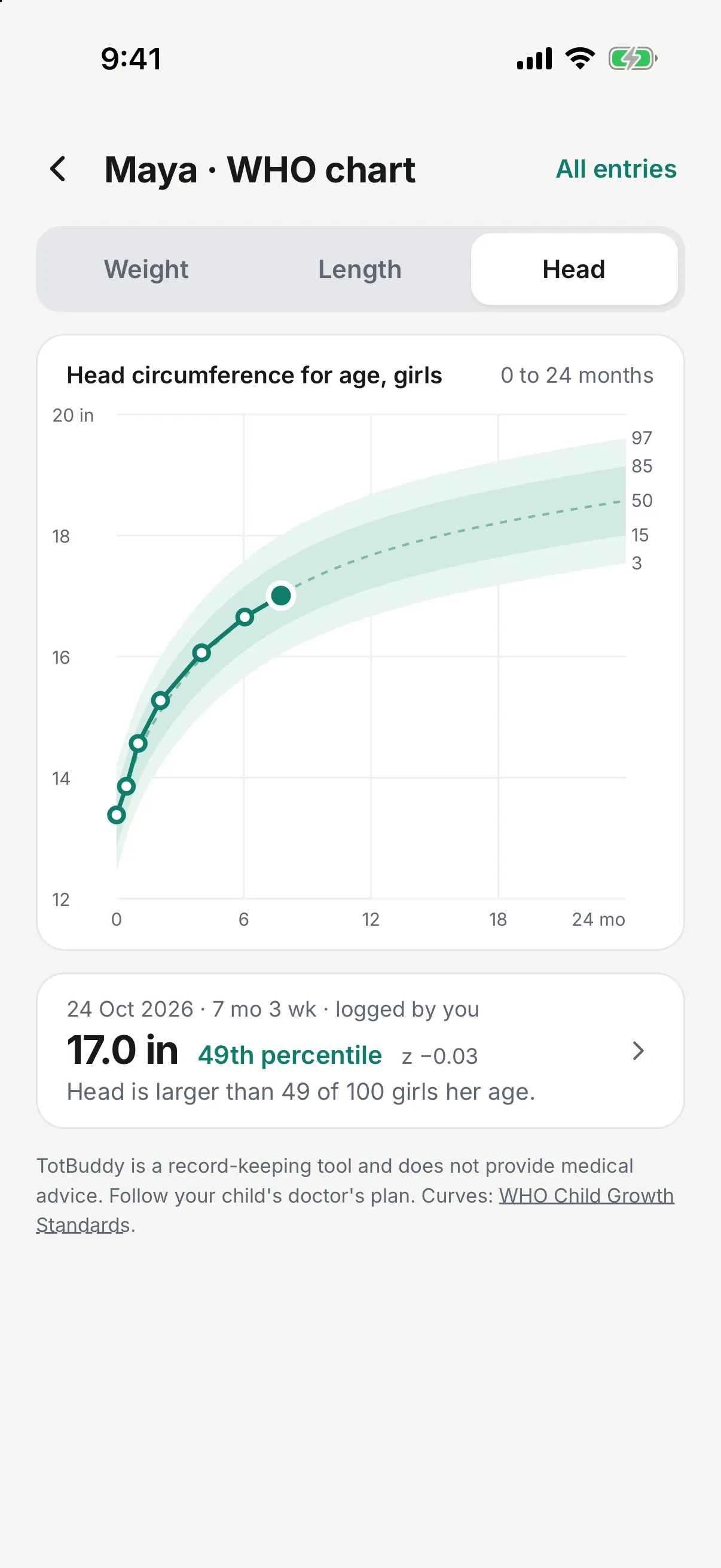
Log a weight, length, or head circumference and TotBuddy plots it on the WHO growth chart for your child's age and sex. Every point shows its percentile, its z-score, and a sentence you can read at a glance.
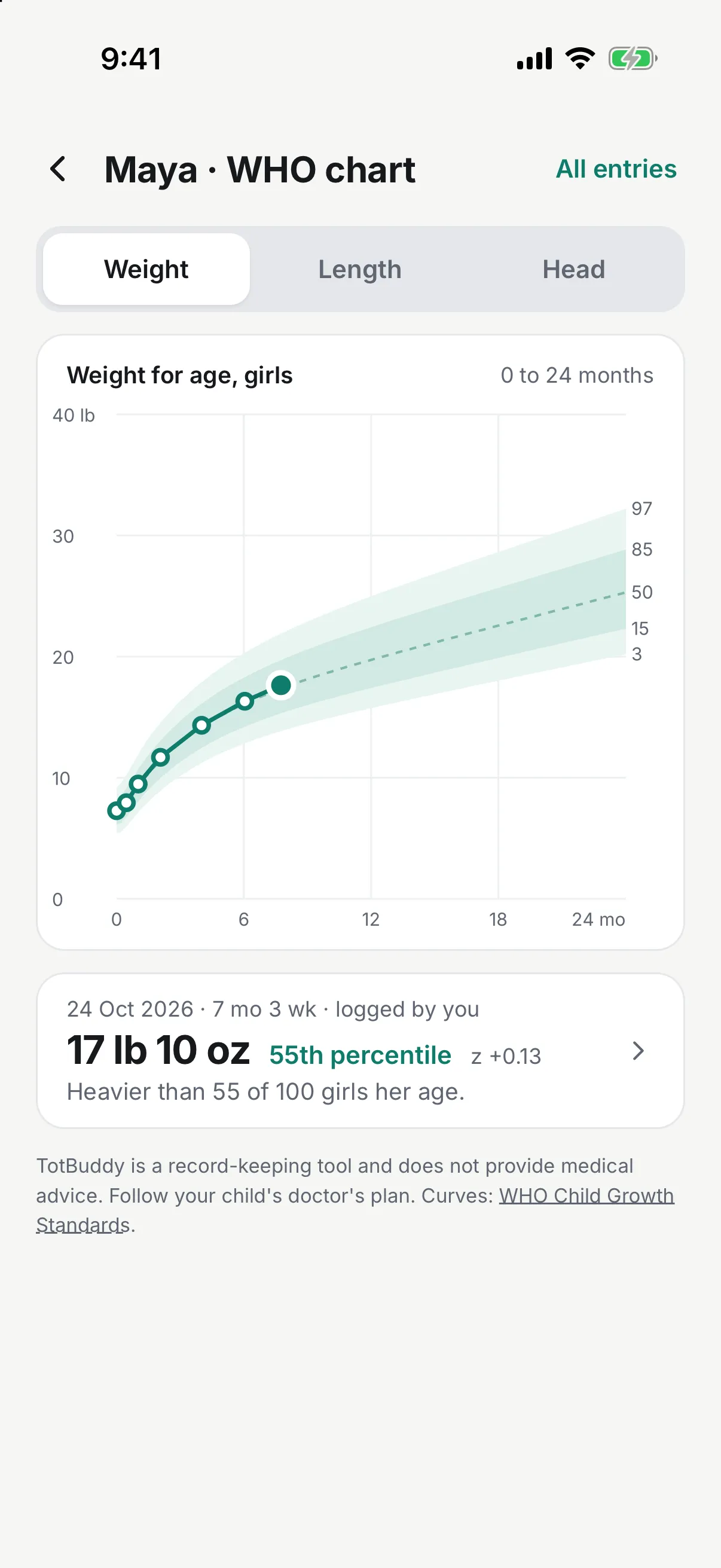
The charts TotBuddy plots
Every chart comes from the WHO Child Growth Standardsand the WHO Growth Reference 2007. The x axis shows 0 to 24 months for a child under 2, so the baby months stay readable.
| Chart | Ages | Source |
|---|---|---|
| Weight-for-age | Birth to 10 years | WHO standards to 5 years, then the WHO 2007 reference |
| Length or height-for-age | Birth to 19 years | WHO standards to 5 years, then the WHO 2007 reference |
| Head circumference-for-age | Birth to 5 years | WHO standards |
WHO publishes no head circumference chart after 5 years and no weight-for-age reference after 10 years. After the fifth birthday TotBuddy hides the head chart, and earlier head measurements stay in the history.
How to read a percentile
A weight at the 55th percentile means that out of 100 girls the same age in the WHO reference group, 55 weigh less. It describes where your child sits today. It is not a score to beat.
The z-score says the same thing in standard deviations from the median. A z-score of 0 is the 50th percentile, and a z-score of 1 is about the 84th. Pediatricians often use z-scores for measurements near the edges of the chart, where percentiles bunch up.
Want one number right now? Use the free baby percentile calculator. It uses the same WHO tables as the app.
Corrected age for babies born early
Corrected age is your baby's age counted from the due date instead of the birth date. To work it out, subtract the weeks your baby was born early from their age. Full term is 40 weeks.
Example
A baby born at 32 weeks arrived 8 weeks early. At 26 weeks from birth, about 6 months, her corrected age is 18 weeks, about 4 months. TotBuddy plots her measurements at 18 weeks.
TotBuddy uses corrected age for any baby born before 37 weeks, until the second birthday. After that, the charts use the age from birth. You only enter the weeks at birth once, and the app does the arithmetic for every measurement.
Length before 2, height after
The WHO tables measure babies lying down until age 2 and standing from age 2. TotBuddy calls the measurement Length before the second birthday and Height after it. If you measured a toddler lying down, or a baby standing up, mark it in the Log sheet and TotBuddy applies the WHO adjustment of 0.7 cm before it works out the percentile.
TotBuddy is a record-keeping tool and does not provide medical advice. Follow your child's doctor's plan.
Growth chart questions
What percentile should my baby be in?
A percentile describes position, not a target. Doctors usually look at how a child's line moves across several visits rather than at one point. Ask your child's doctor what they look for in your child's chart.
Does TotBuddy use the WHO or the CDC growth charts?
TotBuddy uses the WHO charts at every age. The WHO Child Growth Standards cover birth to 5 years, and the WHO Growth Reference 2007 continues height to 19 years and weight to 10 years. In the United States, the CDC recommends the WHO charts for children under 2.
Can I use TotBuddy for a baby born early?
Yes. Add the weeks at birth when you add your child. For a baby born before 37 weeks, TotBuddy plots every measurement at the corrected age until the second birthday.
Can I enter measurements in pounds and inches?
Yes. Enter weight in pounds and ounces or kilograms, and length in inches or centimeters. TotBuddy stores the metric value, so everyone on the record can pick their own units.